What Chemicals are Needed to Close a Pool
https://blog.intheswim.com/what-chemicals-are-needed-to-close-a-pool/
Winter will be here soon, and for Snowbelt pool owners, thoughts begin to turn towards closing up the pool for winter.
Now is a good time to take stock of your pool closing supplies – winter chemicals, pool cover attachments, plugs, and other gizmos used to close the pool.
Today we take a closer look at the chemicals used for winterizing swimming pools – to keep the water fresh and clear and prevent stains and scale on your pool.
What Pool Closing Chemicals Do You Need?
Aside from your water balance chemicals used to adjust pH, alkalinity, or calcium hardness, these are the chemicals most commonly used to winterize pools.
- Chlorine Free Pool Shock: Add 2 days before closing the pool.
- Stain & Scale Treatment: Add 1 day before closing the pool.
- Winter Algaecide: Pour into the pool just before covering.
Should I Shock the Pool Before Closing?
 Shocking the pool, with a granular oxidizer gives your pool water a good start to winter, removing impurities and contaminants that could stain the pool or consume your winter water chemicals. If shocking with chlorine pool shock, add it 5-7 days before closing the pool, as very high chlorine levels can disrupt or destroy your winter algaecide and stain & scale chemicals. Our Chlorine-Free Shock can be added just hours before other pool closing chemicals, and it won’t damage your winter pool cover.
Do I Need to Use a Winter Pool Algaecide?
Many good algaecides for summer use may not perform as well as our Winter Algaecide, which is formulated to ‘hibernate’ until water temperatures rise again next spring. Copper algaecides should be avoided as overuse can lead to staining, and other summer algaecides are not long-lasting. Algaecide 60 Plus is a lone exception, the polymer is a good alternate choice to our Winter Algaecide.
Can I Use My Chlorine Floater During Winter?
Stains or burns can come from a chlorine tablet floater during winter. If it becomes stuck on a step or sits in one area for some time, it can bleach vinyl and stain plaster. Secondly, if it flips over, or if small slivers slip out of the bottom holes, it will discolor or stain pool surfaces. Our Winter Closing Kits however contain a patented chlorine-free sanitizer that slowly dissolves all winter long and will never damage or discolor pool surfaces.
Do I Need a Winter Stain & Scale Treatment?
Stain and Scale treatments are sequestering agents, used to prevent metals like copper and iron from oxidizing and staining pool surfaces. They also prevent salts and calcium minerals from mixing with contaminants to form dirty scales. Stain & Scale also prevents the winter bathtub rings found on many pools after opening. Especially useful for pools with high calcium hardness levels, saltwater pools, and those with safety pool covers.
Should I Use Pool Enzymes During Winter?
Pool Enzymes, popularized by Natural Chemistry, are similar to enzymes used to clean up ocean oils spills. Pool Magic Spring & Fall and the Winter Pill work to break down oily contaminants in the water that can lead to stains and consume your Winter Algaecide. Winter Pool Enzymes are formulated for cold temperatures and long-lasting duration, to remain active until late spring. Pool Magic also contains PhosFree, to remove phosphates that provide food for algae.
Do I Need Pool Antifreeze?
Non-Toxic Pool Antifreeze is used for underground plumbing that is not blown out with something like our Cyclone winterizing blower, or can be added as extra insurance against leaky plugs. Antifreeze is also used to protect a winterized skimmer, as it fills with rainwater over the winter. Do Not use Pool Antifreeze in a pool pump, filter, heater, or chlorinator, but instead remove the drain plugs on each.
Should I Check Water Chemistry During Winter?
In most cases, there is no need to test the water on a covered pool, with the exception of a pool with new plaster or whitecoat, which tends to rise in pH level during the first year. In such cases, pull back the cover and test the pH and alkalinity each month, adjusting as needed before covering the pool again. Pool covers with drains to allow rain and snowmelt to pass through may wish to check pH once or twice during winter, to prevent possible etching or scaling issues.
Will I Need to Add More Chemicals in the Winter?
When sized correctly and added to a clean and clear pool, winter chemicals last for the entire 6-8 month off-season. However, a pool closed with algae, or with a loose-fitting cover, or older safety covers that allow sun and dust to enter, or one that has a wet spot in the middle from a too-high water level – all could benefit from additional algaecide or shocking with chlorine-free pool shock, when water begins to warm in early spring. Pull back a side of the cover 2-4 weeks before opening, and evaluate the need for additional chemicals.
Do I Need to Lower the Water Level for Winter?
In most cases, yes – lower the water level several inches below the tile line and skimmer. Floating Winter Covers typically lower 4-6″ below the skimmer, and Safety Covers typically lower the water 9-12″ below the skimmer. You can use your pool filter pump if you have a main drain or a submersible Pool Cover Pump. Vinyl pools can also use the Skimmer Plug, which seals up the front opening of the skimmer, to avoid lowering the pool water.
Winter Pool Algaecides
There are three main types of algaecides that can be used to winterize a pool: quaternary, polymer and copper-based. Some are stronger than others, and some will last longer and provide better results. Here’s a rundown of various types of pool algaecides that can be used as winter algaecides.
Algaecide 50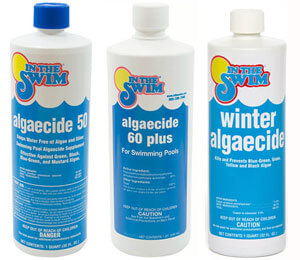 : A polymer algaecide at 50% strength. Non-staining, long-lasting formula. Good for all types of algae.
Algaecide 60+: A polymer algaecide at 60% strength. Non-staining, long-lasting formula. Good for all types of algae.
Winter Algaecide: A chelated (non-staining), long-lasting copper algaecide with 3% elemental copper. Good for all types of algae.
Any of these can be used for pool winterizing algaecides. Generally speaking, the more expensive an algaecide is, the better it will be in terms of longevity and strength. The one you choose and how much you use may be related to your winter pool cover. If you have a solid pool cover in great shape, a cheaper or less potent algaecide can be used. If you have a mesh pool cover or one that lets in sunlight and fine debris, a better algaecide is a must.
If you use chlorine shock to close the pool, it’s best to do so about a week before closing. A very high chlorine level can harm your cover and destroy your algaecide. If you shock with chlorine the day that you close the pool, wait about a month before adding the algaecide – just squirt it under the cover in three or four locations. Another method is to shock the pool hard when you close and wait until early spring to add your algaecide, about 8-10 weeks before you open the pool.
If using copper algaecide, it’s best not to overdose, especially with a plaster pool. Even though these copper algaecides are chelated, there is still a potential for copper staining. The staining potential is much less for vinyl liner pools. Adding a stain preventative is advised (included in our winter chemical kits) if you use copper algaecides, summer or winter.
Winterizing Pool Shock
Shocking your pool before closing is necessary to kill any “undesirables” in the water. Let’s face it, many people tend to drop their guard on pool maintenance in the last few weeks, so a good shocking is a great idea.
Before you shock the pool, clean the pool thoroughly. This is important so the pool shock isn’t wasted attacking leaves and debris in the water. Also make sure that the water is balanced, with special attention paid to the pH and alkalinity levels. If your pH is high on the scale, much of your pool shock could be wasted or become ineffective. Drop the pH level to the low side of the scale, around 7.2, and check that your alkalinity is in the range of 80-120 ppm for best results.
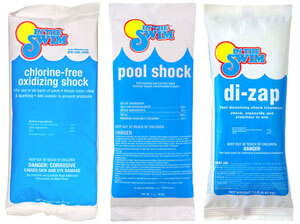 For vinyl pools, non-chlorine pool shock is preferred during winterization. It’s clean-burning (leaves behind no residue), and it won’t harm your vinyl liner. Even for plaster pools, chlorine shock can be harsh for the pool finish and is recommended for pool closing, because it won’t disrupt or destroy other winter pool chemicals, usually added at the same time.
Dichlor shock is often used for opening pools or during the summer, because it is stabilized against the sun. But there is no need to use this more expensive shock if you are adding it just before closing the pool, unless your (mesh) safety cover lets in a lot of sunlight. Regular chlorine pool shock, or non-chlorine pool shock (potassium peroxymonosulfate) is usually the best choice as a winterizing pool shock.
Follow the label instructions to add the proper dosage. If you have visible algae, double the dose, and then brush the pool. As mentioned above, it’s best to shock the pool several days in advance of closing so the shock won’t attack your algaecide or your pool cover.
Stain & Scale Chemicals
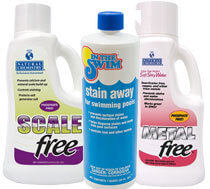 Using a stain and scale preventative chemical when closing your pool is always a good idea. These chemicals prevent mineral and metal staining and should be added to the pool before disconnecting the filter pump and lowering the pool water because it’s important to thoroughly distribute the chemical throughout the pool.
Stain Away is a sequestering agent, or chelator, that keeps minerals and metals tied up in solution and keeps them from staining your pool over the winter. For pools on well water with high levels of iron, magnesium, or copper, use Natural Chemistry’s Metal Free, which keeps minerals in solution without adding any phosphates to the pool. To avoid stains, this product is a must if you use well water.
For hard water areas or those with high calcium hardness over 400 ppm, Natural Chemistry has another product called Scale Free. It’s also recommended for saltwater pools, to keep sodium in solution and keep it from mixing with organic matter, which can make a pool look dull and dirty.

Comments
Post a Comment